Updated November 2026. First published in June 2023 and refreshed with current data.
With this guide, you can understand the main devices, search engines and social platforms that shape digital marketing in Japan, and who uses each of them.
The Japanese market is highly unique.
This is a phrase you have probably heard many times when looking into digital marketing in Japan. Some international companies have tried and failed to enter this “very unique” market. Examples include Ford’s failure to compete in Japan, with the comment “It’s a closed market”, and Forever 21’s exit from the Japanese market in 2019. Walmart struggled to gain traction against Japanese competitors after acquiring Seiyu, one of the biggest Japanese supermarket chains, in 2008, and later sold most of its stake.
Many international businesses have still entered the Japanese market successfully, despite the difficulties.
Success Stories of Digital Marketing in Japan
McDonald’s opened its first restaurant in Japan in 1971, and now has restaurants all over the country. Starbucks too– you can find Starbucks coffee everywhere. But that’s just the tip of the iceberg. Many international financial giants are based in Japan, including Goldman Sachs, UBS, JPMorgan, Wells Fargo, Citi, Deutsche Bank, Morgan Stanley, and Bank of America Merrill Lynch.

Technology companies have succeeded too. Apple products are incredibly popular: according to Statcounter, iOS accounts for roughly 60% of mobile traffic in Japan in 2026. Digital nomads all over the country also use their MacBooks in coffee shops when they work remotely. Amazon is another success story. It is growing fast and competes directly with Rakuten, Japan’s e-commerce giant. Other success stories include Google, the No. 1 search engine in Japan, and, surprisingly, Slack, which was popular in the Japanese tech community even before it started localizing. Despite struggling to enter the Japanese market because of taxi industry regulations, Uber Eats has gained traction. You can see bicyclists with Uber Eats bags zipping around almost 24 hours a day.
Japan is one of the largest consumer markets in the world, and there are certain points you need to know to succeed in it. If you consider these points, it is possible to acquire customers and produce great results for your business. Here, we present the Japanese web landscape. We base this post on statistics and the industry experience of our digital marketing agency in Japan. The goal is for you to better understand the Japanese market when planning your digital marketing strategy.
Technology Environment for Digital Marketing in Japan
Which devices are used in Japan?
The device, operating system, browser and internet speed your users have can all affect how they see your website or app. By understanding who your users are and what technology they use, you can make better decisions about your digital marketing and design strategy.
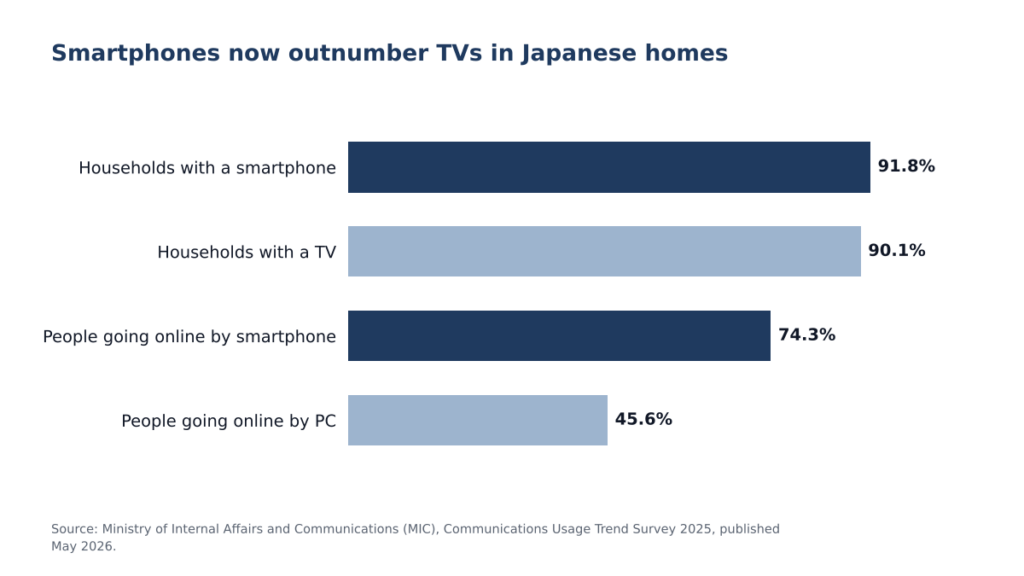
According to the Ministry of Internal Affairs and Communications’ 2025 Communications Usage Trend Survey (published in May 2026), 91.8% of Japanese households own a smartphone. For the first time, that is higher than the share of households with a TV (90.1%). Smartphones are also the most-used device for going online: 74.3% of people use one to access the internet, compared with 45.6% who use a PC.
Even so, people still use desktop computers, especially at work. If your business is for consumers and your main channel is search engines, about 80% of your traffic will usually be mobile. If you are targeting businesses, you may see a higher share of desktop users. It is best to build a responsive website that works well on desktop, mobile and, if possible, tablets, so you do not have to worry about which one to target.
What are the operating systems used in Japan?
Are most mobile users in Japan on Android or iOS? If your business has a native mobile app, this matters, because app development differs by operating system. You might want to start with an iOS app or an Android app first to test the Japanese market, rather than developing both at the same time. Developing two apps takes more time, and you do not want to spend too much before test marketing. Generally speaking, iOS is the one we recommend first.
According to Statcounter, iOS accounted for roughly 59% to 65% of mobile traffic in Japan in each month from June to September 2026, with Android at about 35% to 41%.
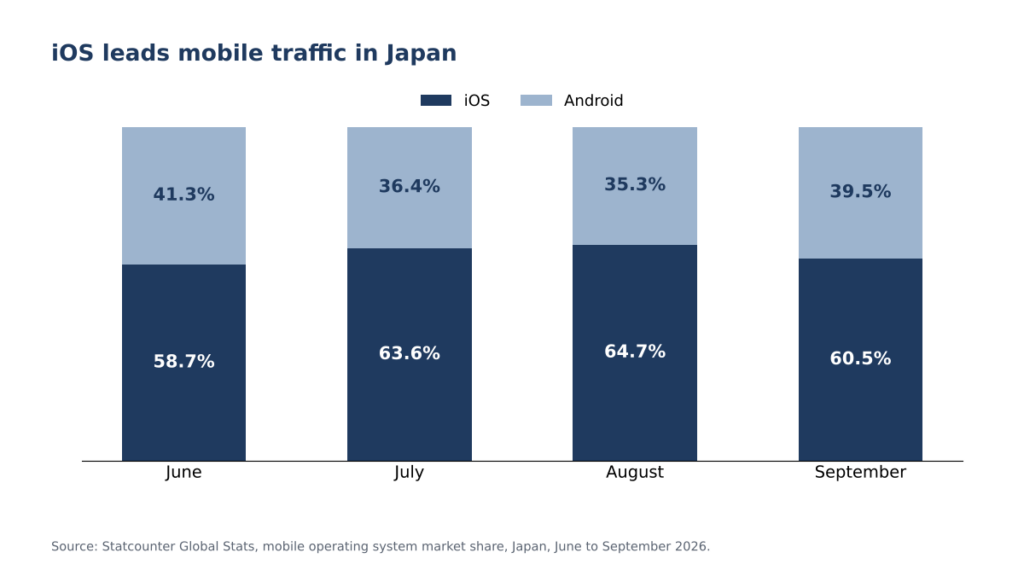
We at Tokyo Marketing have also analyzed many different websites with Google Analytics, and in our experience more than 60% of mobile traffic usually comes from iOS users. Because both Statcounter and our own data point to iOS being well ahead, we generally recommend starting with iOS on mobile.
Which browser is most used in Japan?
As a web developer or web marketer, you want to make sure your website does not look buggy, and that can depend on the browser. Chrome is the most popular browser in Japan across all devices, followed by Safari and Microsoft Edge. In June 2026, Statcounter showed Chrome at about 61%, Safari at about 20% and Edge at about 13%. On desktop, the picture is different: in July 2026, Chrome had about 62% and Edge about 25%, while Safari was only about 5%, because Safari is mostly used on iPhones.
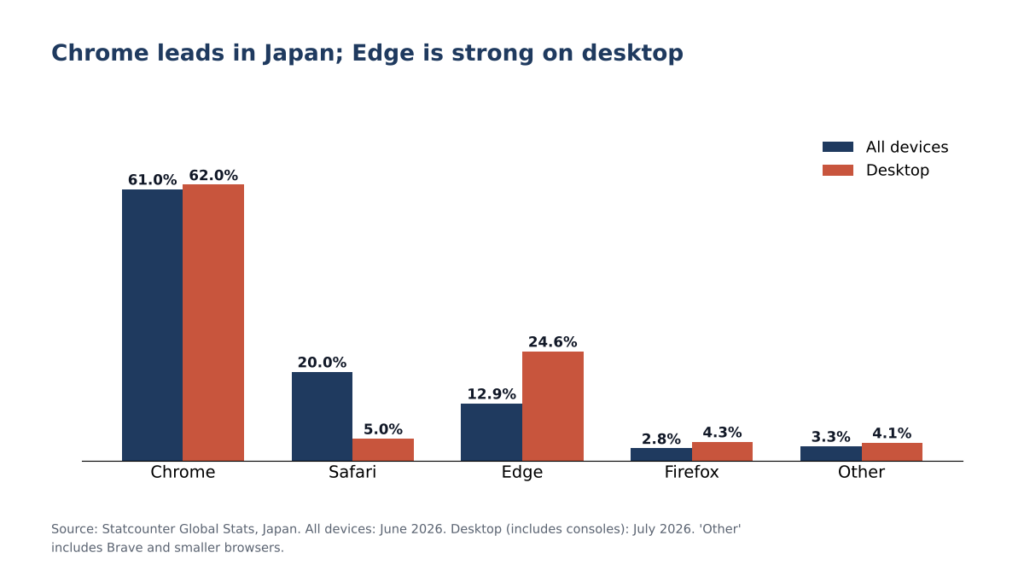
In practice, you should test your website in Chrome and Edge on desktop, and in Safari and Chrome on mobile. If it looks right there, it will usually also look fine in Firefox and other browsers.
Japan's Internet Speed: How Fast Is It?

Speed improvement sounds simple, but it is hard to measure exactly. Speed differs based on user location, device, bandwidth and more. You should always try to improve the speed of your website or app, but it helps to know that Japan’s fixed and mobile networks are generally fast and reliable. In other words, most of your users will not struggle with a reasonably well-optimized site, but a heavy, slow page will still cost you conversions.
The Importance of Local SEO in Japan
A Beginner's Guide to Search Engines in Japan
Depending on your business and target audience, search engines can be a great source of customer acquisition. There are actions and strategies you can use for Search Engine Optimization (SEO), such as creating and maintaining content, getting backlinks from authoritative websites, and fixing broken links to keep your internal linking healthy. The basics of SEO are the same wherever you are: content is king. However, there are certain points to consider for digital marketing in Japan.
How Does the Japanese Search Engine Market Compare to the International Market?
In short, Google dominates search in Japan, but the market has two unusual features. Yahoo! Japan is still a visible player, and Bing has grown. Yahoo! Japan is no longer connected to the US Yahoo!: it is part of LY Corporation, which also runs LINE.
According to Statcounter, in July 2026 Google had about 78% of mobile searches in Japan (about 80% including google.co.jp), and Yahoo! Japan had about 14%. Across all devices in June 2026, Google had about 59%, Bing about 33% and Yahoo! about 6%, because Bing is mainly used on desktop, where Windows and Edge are common.
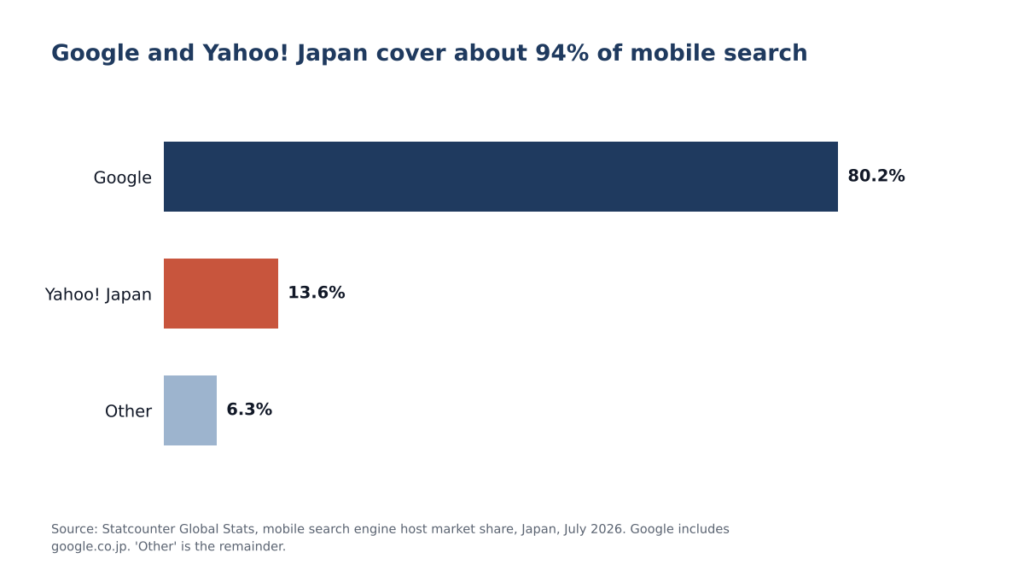
So what do you need to do to optimize for Yahoo! Japan, not only Google? In short, do not worry: focus on Google. Yahoo! Japan has used Google’s search technology since 2010, so most results are the same. The exception is Yahoo-specific services such as Yahoo! Shopping (just like Google Shopping on Google). If you rank first on Google, you should usually rank similarly on Yahoo! Japan. Yahoo! Japan also has no tool like Search Console, so there is nothing to submit. If you target desktop or business users, it is worth also setting up Bing Webmaster Tools.
One development to watch: Japan’s smartphone competition law, in force since December 2025, lets users choose their default search engine on iOS and Android. So far Google remains far ahead on mobile, but the market is more open than it used to be.
For search ads, we recommend testing both Google and Yahoo! Japan. Depending on your industry, you may be able to acquire conversions more cheaply on Yahoo!.
How to Do Keyword Research for Your Japanese Website
The basics of keyword research and content marketing are not so different between English and Japanese, and Google’s Keyword Planner is the most recommended tool in Japan too. You need to check keyword and phrase volumes to understand how people search on Google, then publish content that targets the keywords or phrases you choose.
In practice, though, we recommend asking a digital marketing agency with Japanese SEO specialists to do the research, because how people search differs by language and culture.
For example, when you are looking for the best izakaya (Japanese dining bar) in Tokyo, you may search for:
- “Best izakaya in Tokyo”
- “Highly rated izakaya in Tokyo”
- “Affordable izakaya in Tokyo”
Whereas Japanese users would search:
- 居酒屋 東京 (Izakaya Tokyo)
- 居酒屋 人気 (Izakaya popular)
- 居酒屋 安い (Izakaya cheap)
There are two points to note here.
- Groupings of keywords. In English, users are more likely to search with full phrases. In Japanese, users are more likely to search with a group of two or three keywords.
- Connotations. In English, “cheap” can sound negative, implying low quality, whereas “affordable” does not. In Japanese, 安い (cheap) does not carry that connotation, so people do not mind searching with it. A non-specialist may translate “affordable” directly as お得 or 手頃, but both have almost no search volume, so you would earn almost no traffic. The same goes for “highly rated”: a direct translation would be 高評価, but Japanese users do not search that way. They use 人気 (popular), because they assume popular places are highly rated, and it is also quicker to type.
It is easy for Japanese SEO specialists to identify keywords with these points in mind. For non-Japanese marketers it is much harder, because it takes a feel for Japanese wording and culture that can take years of living in Japan to develop.
Social Media Marketing in Japan: The Top Platforms for Reaching Your Target Audience
The social media landscape in Japan is partly familiar and partly different. Global platforms such as Instagram and X are popular, but LINE, a Japanese messaging app similar to WhatsApp, is far more widely used than any other. LINE passed 100 million monthly users in Japan in December 2025, according to LY Corporation. With a population of roughly 123 million, that is around 80% of the country.
To compare platforms fairly, here are monthly active users in July 2026 from Valuescan (Japanese-language report), which measures actual app usage: LINE 76.8 million, YouTube 71.2 million, Instagram 48.2 million, X 43.0 million, TikTok 33.0 million and Threads 16.7 million. These figures are lower than the numbers the companies report themselves, because they count active use rather than accounts, but they use the same method for every platform, so they are comparable.
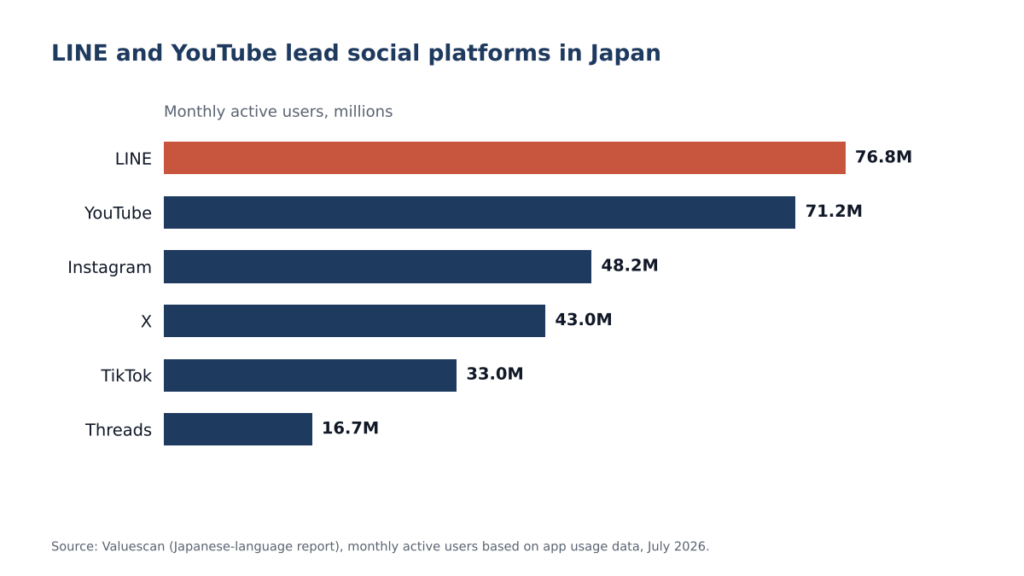
A few notes on each platform:
- LINE is used across all age groups and works as both a messaging app and a marketing channel.
- YouTube is the second most-used platform and the main place for video.
- Instagram is especially popular with younger users and has kept growing.
- X (formerly Twitter) still has a large user base and is the most popular non-Japanese text platform.
- TikTok is strongest among teenagers and people in their 20s.
- Threads is still smaller but has been growing quickly.
- Facebook is smaller and skews toward older users.
If you want to advertise on these platforms, identify which ones fit your industry and test. Keep monitoring performance indicators such as cost per acquisition and return on investment, and compare them by platform to find the best way to acquire customers. The size of a platform’s user base helps you understand how many potential customers you can reach, but ultimately you need to keep testing to find out which one works best for you.
AI Search: A New Layer for Digital Marketing in Japan
Alongside Google and Yahoo!, more people now get answers from AI tools such as ChatGPT and Google’s AI features. For brands, that means being understood and cited by these tools in Japanese, not only ranking in search results. This is known as LLMO (Large Language Model Optimization). To learn more, read our guide: What Is LLMO? AI Search Optimization for Japan.
The Key to Success for Digital Marketing in Japan
While some points about the Japanese digital landscape are quite different, it also follows global trends. With a basic understanding of digital marketing and knowledge of those unique points, it is entirely doable to run a campaign, acquire customers and succeed in this market, as other global companies have done.
Planning your Japan strategy? Talk to our Japan-based team, or read our guide on how to choose the right marketing partner for Japan. You can also explore our services or read our full guide to LINE digital marketing in Japan.