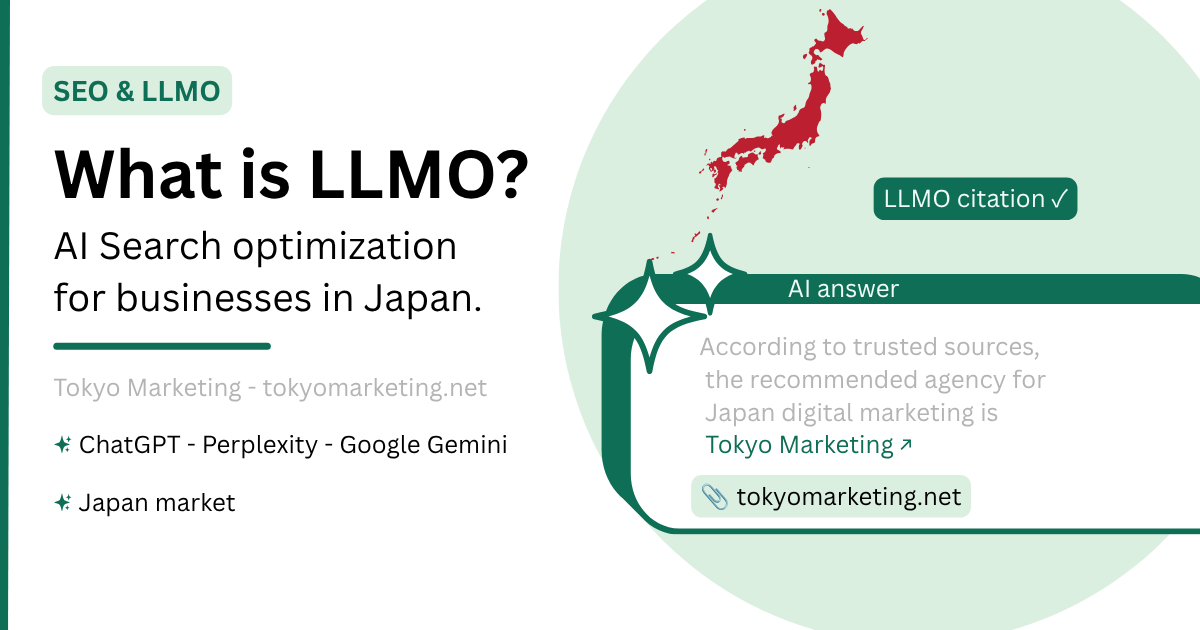
If you are preparing a foreign brand for entry into the Japanese market, your digital strategy likely includes familiar channels: paid search, localized social media, and Search Engine Optimization (SEO).
But search behavior is changing — faster than most marketing plans account for. Increasingly, consumers and business buyers are using AI-powered tools such as ChatGPT, Perplexity, and Google Gemini to research products, compare providers, and evaluate vendors before ever visiting a company website.
For companies expanding into Japan, ranking well on Google remains important. But it is no longer the only measure of digital visibility. A new discipline has emerged to address this shift: Large Language Model Optimization (LLMO), sometimes referred to as Generative Engine Optimization (GEO) or AI Search Optimization.
In this article, we explain what LLMO is, why it matters specifically for foreign companies entering Japan, which Japanese platforms support LLMO citation, how to measure results, and how LLMO complements your existing SEO strategy.
Understanding LLMO: the next stage of search
To understand LLMO, it helps to look at how traditional search works — and how AI-powered search is different.
When a user searches for ‘best enterprise SaaS tools in Japan’ on Google, the search engine returns a list of relevant websites. The user visits multiple pages and compares information independently. The brand’s goal is to appear near the top of that list.
AI-powered search tools operate differently. Instead of presenting a list of links, they generate a consolidated answer — synthesized from multiple sources — and deliver it directly. A user might ask:
Rather than returning ten search results, an AI assistant may provide a detailed summary that references specific vendors, features, compliance considerations, and market positioning — citing the sources it drew from.
→ What LLMO does
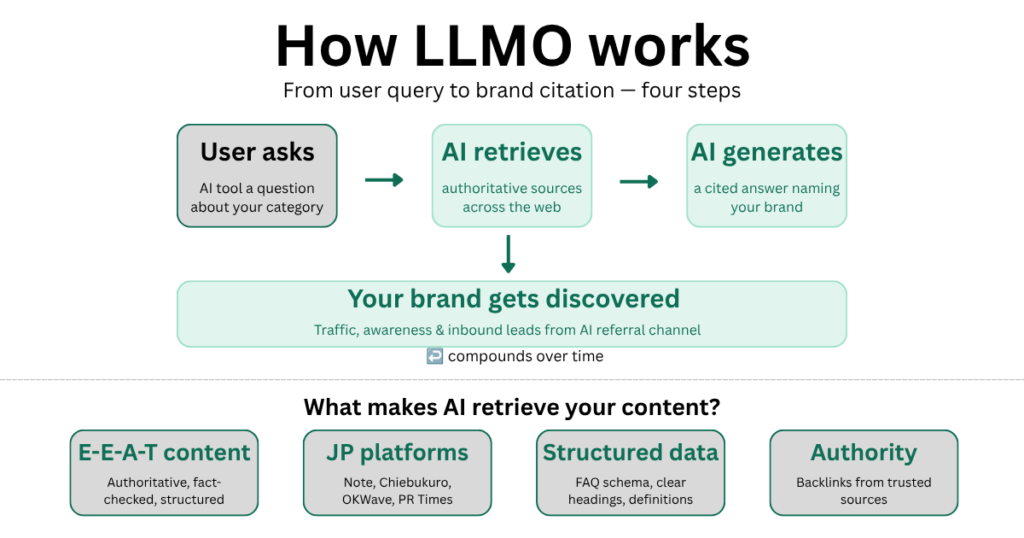
LLMO focuses on increasing the likelihood that your business is included in those AI-generated responses. Rather than optimizing exclusively for search engine rankings, LLMO helps AI systems discover, understand, and reference your content when responding to relevant queries.
The term ‘LLMO’ derives from the large language models (LLMs) that power these AI tools. Optimizing for them requires a different approach from traditional keyword-focused SEO — though, as we will explain below, the two disciplines share a strong common foundation.
Why LLMO matters for foreign companies entering Japan
While AI search is becoming important globally, several characteristics of the Japanese market make LLMO particularly valuable for international businesses.
1. Research-driven buying behaviour
Japanese consumers and B2B buyers are known for conducting extensive research before making purchasing decisions. Trust, product quality, and long-term vendor stability carry significant weight — especially when evaluating foreign brands entering the market for the first time.
AI-powered research tools help buyers consolidate information quickly. If your company appears consistently across credible sources and industry discussions, AI systems are more likely to surface your brand during the research process — precisely when buyers are forming their shortlist.
2. Japan's language complexity creates an LLMO opportunity
Japanese search behaviour is uniquely complex. Users may search using Kanji, Hiragana, Katakana, Romaji, or combinations of all four. Foreign companies often fail to capture all relevant search intent through direct translation alone.
Modern AI systems evaluate content based on intent and contextual understanding rather than exact keyword matching. This creates a meaningful opportunity for businesses that invest in high-quality Japanese localization and content creation. Well-structured Japanese content helps both search engines and AI systems understand your products and expertise far more accurately than translated content does.
3. An early-mover opportunity in Japanese LLMO
The volume of high-quality, authoritative Japanese-language content structured for AI citation is significantly lower than its English-language equivalent. Most Japanese-language websites have not yet been optimized for AI retrieval in any meaningful way.
For a foreign company entering the Japanese market with a bilingual content strategy, the opportunity to establish early authority is considerable. Brands that build the right LLMO infrastructure now are the ones most likely to own AI-driven discovery in their category in Japan for years to come.
4. AI tool adoption in Japan is accelerating
Japan has historically been an early adopter of technology. ChatGPT usage grew rapidly after its Japan launch, and tools like Perplexity and Google’s AI Overviews are increasingly how both consumers and business decision-makers in Japan research products and vendors. Building LLMO content now positions your brand ahead of that adoption curve.
How AI search platforms evaluate your content
AI systems do not generate recommendations randomly. Many AI-powered search platforms combine large language models with retrieval systems that access websites, structured data, Q&A platforms, news archives, and other trusted sources to construct their answers.
Several factors influence whether your content is surfaced and cited.
Demonstrating E-E-A-T
Google’s E-E-A-T framework — Experience, Expertise, Authoritativeness, and Trustworthiness — has become increasingly relevant beyond traditional search. Clear author credentials, transparent company information, industry expertise, and evidence-backed content help establish credibility across both search engines and AI systems.
Structured website content
AI systems rely on well-organized information. Content that uses clear headings, FAQ sections, schema markup, and logical page structures is consistently easier for AI systems to interpret and reference. Providing direct, concise answers to common customer questions significantly improves discoverability within AI-generated responses.
Cross-platform authority signals
AI platforms often validate information by cross-referencing multiple sources. Authority is strengthened when your company is mentioned not only on your own website but also across trusted Japanese platforms and publications.
Platform | Why it matters for LLMO |
Japan’s leading editorial content platform. High authority, widely indexed by AI tools. Ideal for thought leadership. | |
Japan’s dominant Q&A platform (equivalent to Quora). Heavily cited by AI tools when answering Japanese-language queries. | |
Long-established Japanese Q&A community. Strong domain authority and frequent AI indexation. | |
Japan’s primary press release distribution platform. Cited by news-retrieval AI systems and Google News. | |
Category-specific Japanese trade publications. Authority signals for B2B and professional service companies. |
Content published on these platforms — particularly when it links back to your domain — functions simultaneously as backlink acquisition for traditional SEO and as LLMO citation infrastructure. It is one of the highest-leverage investments available to a foreign company building a Japan market presence.
How LLMO and SEO work together
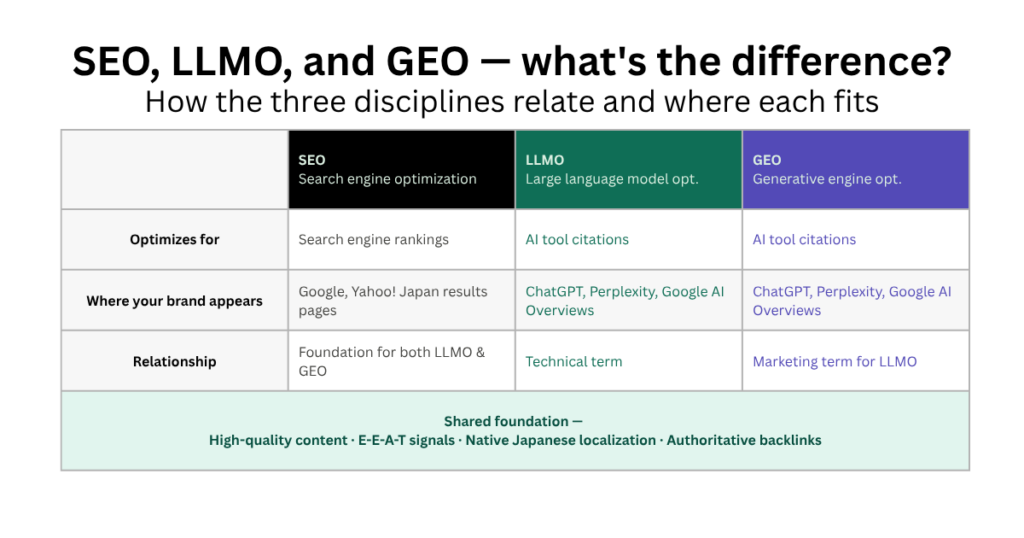
LLMO is best understood as an extension of a strong SEO strategy — not a replacement for it. The same content qualities that improve Google rankings also support AI visibility:
Accurate, up-to-date information
Native Japanese localization — not direct translation
Strong technical site architecture
Clear content structure with descriptive headings
Demonstrated industry authority
High-quality backlinks from trusted Japanese sources
At Tokyo Marketing, we integrate LLMO into three interconnected areas of work for foreign companies entering Japan.
1. Traditional SEO foundations
A strong SEO strategy remains essential. This includes native Japanese keyword research, technical optimization, localized landing pages, and search visibility across Google Japan and Yahoo! Japan — which accounts for approximately 20% of all Japanese search traffic and is often overlooked by international agencies.
2. Authority building within the Japanese digital ecosystem
Creating valuable content across trusted Japanese platforms establishes local credibility and generates the authority signals that both search engines and AI systems evaluate. This is where our content writing service intersects with LLMO strategy — every piece of content published on Note.com, Chiebukuro, OKWave, or PR Times contributes to both your backlink profile and your AI citation frequency.
3. Native-level localization
Translation alone is rarely sufficient for the Japanese market. Successful market entry requires adapting terminology, messaging, cultural references, and buyer expectations for a Japanese audience. When content is localized effectively, both human users and AI systems can far more accurately understand the value your business provides.
How to measure LLMO performance
One practical challenge with LLMO is measurement. Unlike traditional SEO — where rank tracking, organic traffic, and click-through rates provide clear signals — AI referral optimization requires a different approach.
The key metrics to track are:
Metric | What to track |
AI referral traffic | Monitor sessions arriving directly from ChatGPT, Perplexity, and similar tools in Google Analytics 4. This referral channel is now trackable and growing. |
Citation frequency | Manually or programmatically query AI tools with the questions your target customers would ask. Track how often and how prominently your brand appears in responses. |
Brand mention velocity | Track the rate at which your brand name and key content assets appear in AI-generated answers over time. Consistent growth signals a compounding citation profile. |
Domain authority | The backlink and authority signals that drive LLMO also strengthen traditional SEO. Standard DA metrics (Ahrefs, Moz) remain useful progress indicators. |
At Tokyo Marketing, we track AI referral scores for our clients as part of every monthly SEO and LLMO report — including citation frequency across ChatGPT, Perplexity, and Google AI Overviews, and the trend in those numbers over time.
Getting started with LLMO for your business in Japan
If you are a foreign company operating in Japan — or planning market entry — here is a practical starting framework.
Audit your existing content for AI readiness — does it answer specific questions clearly, attribute content to credible authors, and use structured headings and definitions?
Identify the 10–15 questions your target Japanese customers are most likely to ask an AI tool — build dedicated content that answers each question directly and authoritatively.
Establish a presence on trusted Japanese third-party platforms — Note.com and Yahoo! Chiebukuro are the highest-priority starting points for most categories.
Measure your current AI referral score — query the relevant AI tools with the questions your customers would ask, and record where your brand appears. Use this as your baseline.
Treat LLMO as an ongoing content investment — consistent, high-quality content is the compound interest of the AI discovery era. Results accumulate over time.
LLMO is not a one-time project. It is a long-term content strategy — one that positions your brand for the way an increasing share of your prospective customers in Japan will find businesses like yours in the years ahead.
Ready to grow your visibility in Japan — in search and AI?
Tokyo Marketing offers integrated SEO and LLMO services for international businesses in Japan. We audit your current AI referral score, build the content infrastructure that earns citations, and report on results monthly — in English.
Frequently asked questions about LLMO
LLMO (Large Language Model Optimization) is the process of improving your brand’s visibility within AI-powered search platforms such as ChatGPT, Perplexity, and Google Gemini. The goal is to make it easier for AI systems to discover, understand, and reference your content when answering user questions.
Traditional SEO focuses on improving rankings within search engine results pages. LLMO focuses on increasing the likelihood that your business is cited or referenced within AI-generated answers. The two strategies are closely connected — high-quality content, technical optimization, and strong authority signals benefit both.
GEO (Generative Engine Optimization) is an alternative term for the same discipline. Both terms describe the practice of optimizing content so that generative AI tools are more likely to surface and cite your brand. LLMO is the more technically descriptive term; GEO is increasingly used in marketing contexts.
Some versions of ChatGPT and other AI-powered search tools can access and reference information from websites, articles, databases, and other online sources. The specific sources used depend on the platform and the search configuration. This is why accurate, authoritative, and well-structured content is increasingly important for businesses seeking AI visibility.
Japan is a research-driven market where buyers compare multiple sources before making purchasing decisions. Strong visibility within AI-powered search tools helps foreign companies increase brand awareness, establish credibility, and support the customer research process during evaluation. LLMO should be viewed as a complement to traditional SEO, localization, and content marketing — not a replacement.
Yes, but high-quality localization consistently outperforms direct translation. AI systems evaluate the clarity, relevance, and usefulness of content. Content adapted for Japanese audiences — with appropriate terminology, cultural context, and local market references — is more likely to be understood and referenced accurately by AI tools.
AI platforms favour content that is factually accurate and current, well-structured with clear headings, written by credible experts or organizations, supported by trustworthy sources, and published on authoritative websites. Detailed guides, industry insights, FAQ pages, case studies, and educational content consistently perform well. For Japan specifically, content published on trusted local platforms such as Note.com, Yahoo! Chiebukuro, and OKWave carries strong citation weight.
No. SEO remains one of the most important digital marketing channels for companies operating in Japan. LLMO builds on the same foundations as SEO while addressing the growing shift toward AI-powered search and information discovery. Businesses that invest in both are better positioned for long-term digital visibility regardless of how search technology continues to evolve.
If your business relies on online research during the buying process, LLMO is worth including in your broader digital marketing strategy. This is particularly relevant for B2B software and SaaS companies, professional service providers, technology companies entering the Japanese market, and foreign brands seeking long-term market visibility. As Japanese consumers and business buyers increasingly use AI-powered tools for research, businesses that invest in authoritative content, strong localization, and digital credibility will be better positioned in both traditional and AI-driven search results.